Jamshedji Constro
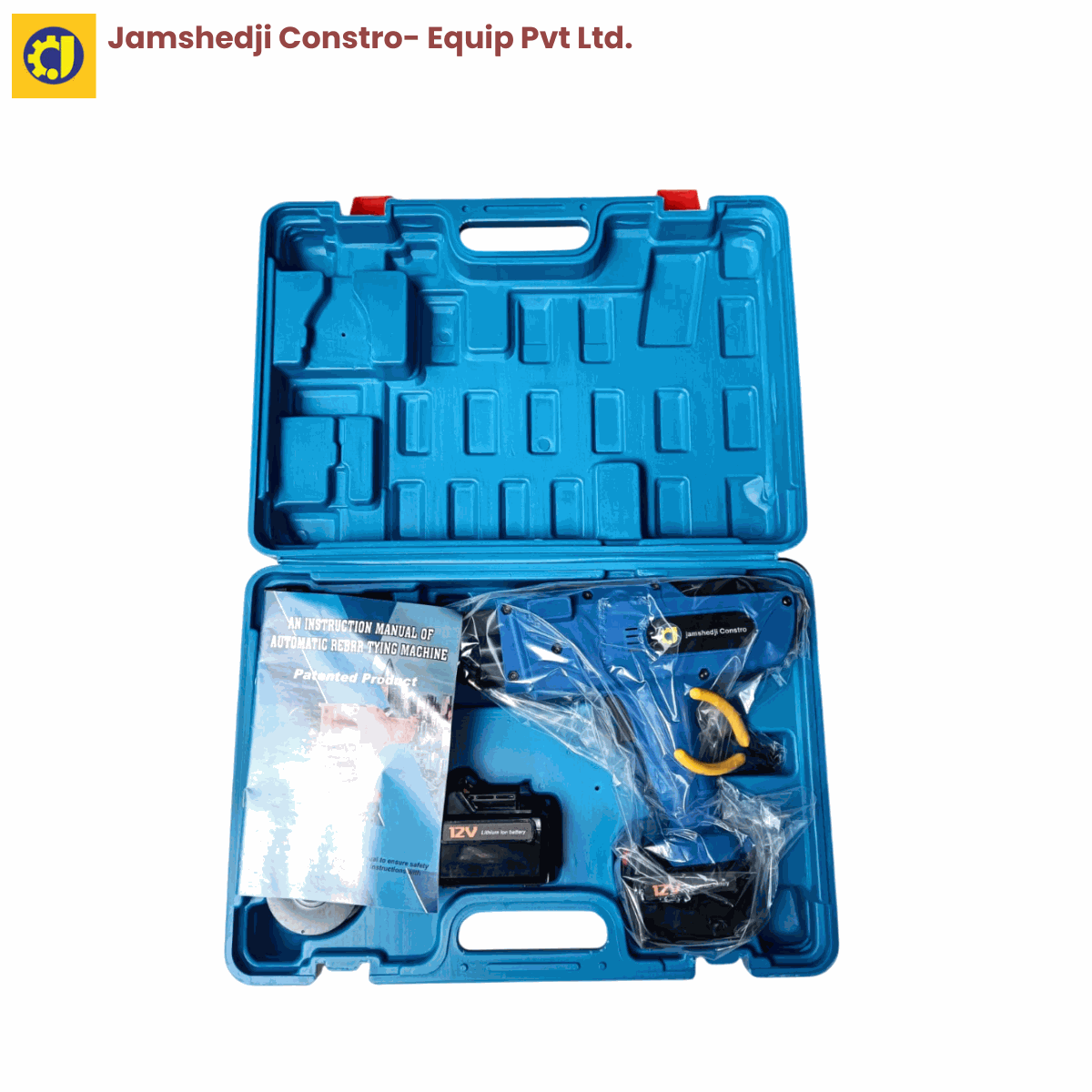
Rebar Tying Machine – Battery 12V, TMT 8 to 34mm, 1 Sec/Knot
Rebar Tying Machine – Battery 12V, TMT 8 to 34mm, 1 Sec/Knot
The Jamshedji rebar tying machine is a battery-powered handheld tool that ties an 8–34 mm rebar intersection in about one second, using 0.8 mm iron tie wire and delivering roughly 225 knots per coil. On a 12 V lithium-ion battery giving six hours of runtime, it replaces hand-tying with pliers on slabs, foundations, columns, beams and precast cages. Weight 1.36 kg.
Key specifications at a glance
- Rebar capacity: 8–34 mm intersections
- Tie speed: approximately 1 second per knot
- Battery: 12 V lithium-ion, 13,200 mAh
- Runtime: up to 6 hours
- Charge time: 2.5 hours
- Weight: 1.36 kg
Why a tying machine changes the labour math
Rebar tying is the invisible bottleneck on any large pour. A worker tying by hand with pliers averages roughly one knot every four to six seconds, and forearm fatigue drops the pace steadily through the shift. Missed or loose ties then let bars shift when concrete arrives, which shows up later as cover problems on the finished element.
This machine ties in about a second. The wire feed, twist and cut happen automatically, so knot tension is the same at the two thousandth tie as at the first — which is what removes the shift problem. On a slab or a column cage it is common for a single machine to replace two or three hand-tiers, and the operator finishes the day without a numb wrist.
At 1.36 kg it stays comfortable overhead, which matters when tying beam and column cages more than it does on a floor slab.
Key features
- Automatic feed, twist and cut — one trigger press per tie
- 8–34 mm intersection capacity covers slab, column and beam bar
- 0.8 mm annealed iron wire; roughly 225 knots per standard coil
- 12 V 13,200 mAh lithium-ion battery, 6-hour runtime, 2.5-hour recharge
- Consistent knot tension across the whole shift — no operator drift
- 1.36 kg — usable overhead without wrist strain
- Works in the same yard as the ring making machine and CNC stirrup bender
Where it is used
RCC slab reinforcement, foundation and pile-cap grids, column and beam cage assembly, precast element production, and any large-volume tying where the pace of manual work becomes the constraint on the pour date. The machine works both at the rebar yard for pre-tied cage assembly and on site for slab-level tying.
Where it fits in the fabrication yard
Straight bar comes off a GQ45 bar cutting machine or GQ50 bar cutting machine, is bent on a GW42 bar bending machine, and stirrups are formed on the ring making machine or the CNC automatic stirrup bending machine. Helical reinforcement for circular columns and piles is rolled on the rebar spiral bending machine. The tying machine is the final step that turns the loose bars into a cage.
For vertical splices, threaded couplers replace lap ties on high-rise and heavy foundation work.
Full specifications
| Type | Battery-operated automatic rebar tying machine |
| Function | Rebar intersection tying |
| Bar size | 8–34 mm |
| Power | 12 V rechargeable lithium-ion battery |
| Battery capacity | 13,200 mAh |
| Battery backup | up to 6 hours |
| Charging time | 2.5 hours |
| Tie speed | approximately 1 second per knot |
| Iron wire diameter | 0.8 mm |
| Knots per coil | up to 225 |
| Weight | 1.36 kg |
| Dimensions | 605 × 170 × 275 mm |
| Brand | Jamshedji |
| Supplied by | Jamshedji Constro Equip Pvt. Ltd., MIDC Bhosari, Pune |
Consumables
Standard 0.8 mm annealed iron tie wire coils are the consumable, giving roughly 225 knots each. Keep enough coils on site for the shift — the tying pace is fast enough that empty coils are usually what stops the machine, not battery life.
Buying, GST and delivery
- Supplied with a GST invoice (18% GST — CGST + SGST within Maharashtra, IGST interstate), ITC eligible
- Sold outright — Jamshedji Constro Equip does not rent or hire equipment
- Dispatched F.O.R. Pune to sites across India, plus export to Bangladesh, UAE, Kenya, Tanzania, Sri Lanka and Nepal
- Backed by a supplier established in 1983, ISO 9001:2015 and MSME/Udyam registered, with 5,000+ clients
Frequently asked questions
How fast is a rebar tying machine compared with hand tying?
Roughly one second per knot against four to six seconds by hand, and knot tension stays consistent throughout the shift. On a large pour a single machine typically replaces two or three hand-tiers.
What bar sizes can it tie?
Intersections of 8 to 34 mm rebar, which covers slab mesh, column and beam cages and most foundation grids.
How long does the battery last on a shift?
Up to six hours of runtime from a full charge, with a 2.5-hour recharge. On practical use the tie-wire coil is usually what runs out first, not the battery.
What tie wire does it use?
0.8 mm annealed iron wire, supplied in coils giving approximately 225 knots each. Any 0.8 mm annealed tie wire in the correct coil format will fit.
Is it heavy enough to be uncomfortable overhead?
At 1.36 kg, no — that is roughly the weight of a small cordless drill. Overhead tying on beam and column cages is where the weight matters, and this is deliberately light enough to make that sustainable.
Does it work in the rain?
The tool is intended for normal site conditions. Continuous use in heavy rain is not recommended, both for the electronics and for operator safety.
What is the price of a rebar tying machine in India?
Send your project location and expected daily volume on WhatsApp for a GST-inclusive quotation including freight and starter tie-wire coils.
Get a GST-inclusive quotation — tell us your rebar sizes and expected daily tying volume and we will confirm the machine, tie-wire coils and delivery schedule.
Available with delivery across India — see all construction machinery across India or browse the full TMT bar machines range.
Share